How to Automate the Gemba Board Effectively

The workplace today has vastly evolved with the solutions, methods, and platformsthat now exist to better manage the challenges and inefficiencies impactingtheir day-to-day productivity. One of those tools, not as commonly known, but still highly effective is a GembaBoard. Gemba is Japanese for “the actual place.” When it comes to businesses,committees, or us as individuals trying to improve processes, we often askwhere the actual problem lies, and from there we craft our solution. The GembaBoard does just that – and we’re going to show you how. What is a Gemba Board? A Gemba Board is a visual management tool that works cohesively with your existing set of solutions and systems to monitor how productivity, communication, and the usual modus operandi process can shift to help improve, restructure, or bring greater stability within the organization. This form of transparent knowledge sharing pushes the business to find balance and behave as one functional ecosystem. The Importance of a Gemba Board In order to achieve the benefits of a Gemba Board and capitalize on what it offers, it’s critical to take a step back and understand the true importance of a Gemba Board. It’s not just another software to add to the pile, or a tool that gets implemented but then goes left unused; rather it is a way of thinking, a full mindset for the organization to embed into their daily work to better manage workflows and processes. It all starts by looking in “the actual place” as Gemba states – by doing what is known as a Gemba Walk. The Gemba Walk introduces leaders and managers to meet their business head-on in a way they may not always have the time or means to conduct this full analysis. Its main focus is to be an active learning and engagement experience where those managers inhale everything in front of them without taking a reactive or defensive position. The goal is to observe, obtain, and have open dialogue. Through their own eyes in this process, top leaders and executives gain that granular and essential perspective into the work that drives their bottom line, while making it a priority to let their teams feel seen AND heard. It provides an objective analysis rather than an assumptive one that can often take course when leaders want a solution but need somewhere or someone to hold accountability. How to Use a Gemba Board The value of a Gemba Board is not partial to just one industry or one style of workplace, although there are some workplaces that may benefit more from the use of a Gemba Board and its analysis. Where there is a need for direct transparency on the status of information that may have an impact on results performance, quality measures, or operational productivity, this is where a Gemba Board finds it fitting in creating real value. This may be a shop floor and a front-line team, a triage department and a team of nurses, in-service training and Human Resources, or a board committee and executive leaders. These all exemplify where a Gemba Board is most necessary – for clean, digestible data visibility for anyone involved, at any level. Everyone should play a part in its management to ensure measurables are accurate and only require a quick glance to be fully understood. What Should be Displayed on a Gemba Board? Your Gemba Board needs to work with you and your team, in how you process information, make decisions, and analyze solutions when multiple problems may be coinciding. The best way to answer the question of what should be displayed on boards, is to decide on the areas that cannot afford much error, play a significant role in influencing revenue, and require everyone’s attention, not just a select few. From there, a Gemba Board should leverage the benefits of color theory, visual perception tactics, and real-time information analysis that data visualization also utilizes. Take these into consideration as you decide the KPIs and measurables that demand this targeted attention. As for the specific columns and rows to include in your Gemba Board for tracking and keeping everyone accountable, here are some Gemba board examples of column title ideas: 5 Tips for Starting a Gemba Board Now that you know what’s valuable to include, it’s time to build your process and analysis. Looking to get started? Here at Bearex we have 5 tips that will get you going on your first Gemba Board layout. Tip #1 – Keep it Active Talk the talk, and walk the walk. Do not neglect your Gemba Board after the initial efforts that went into the evaluation, observation, and engagement process by those on your team. Considering the fact everyone will be looking at this on a daily basis so you need to ensure the data remains timely and accurate. This also means your Gemba Board too should receive an analysis from time to time, asking whether you should measure anything differently, share it in a new way, or create a new category altogether if deemed necessary. Tip #2 – Make it Engaging Since the whole point of a Gemba Board is to keep it up for constant awareness, you also want to keep in mind the risk of letting it go hidden because it becomes habitual. It is also a people management tool, not with the same individual improvement purpose of performance reviews, but it should inspire communication and drive accountability. When you analyze your measurables and processes, take time to assess your people too and how different departments may take turns sharing top insights or how varying levels within a team can use it to facilitate discussion. Tip #3 – Encourage Collaboration This tip is most valuable at the beginning setup stages of your Gemba Board, and can even be talked about during the Gemba Walk process. When employees and managers talk through pain points, daily action, and workflow status, make it known that everyone’s opinion can also go into the contents of the boards. Every role and
What it Takes to Build Accountability with Data Visibility

It’s time for your data to provide more value. “Measurement is the first step that leads to control and eventually to improvement. If you can’t measure something, you can’t understand it. If you can’t understand it, you can’t control it. If you can’t control it, you can’t improve it.” H. James Harrington As we discussed in our latest blog post on how businesses can use data to improve performance reviews, it becomes incredibly more difficult to uncover an area for improvement when the core of it is unmeasurable. Whether we are consciously aware of it or not, employees rely on this sense of measurement and control to know what direction they are to go in; and some rely even more heavily on it to develop the motivation required to go in that direction in the first place. At times, there are tasks or roles that are simply not fit for someone; whether they are outside their realm of experience, beyond their current bandwidth, or dealt to them without adequate resources. While individual reviews work to help identify whether certain behavioral and performance results are tied to these skill level abilities vs purely motivational levels, a measure of group performance works to help the team as a whole regardless of these factors. When team members can see where they stand on broad performance measurables amongst their peers, it’s not always a means for competition or comparison, but more of a tactic to fill the gaps with enhanced performance when all it may take is greater motivation from a select few. The Answer is in the Data Performance output levels will never be the same across the board, it’s inevitable that every organization has those that are considered top performers, and those that aren’t always delivering to their expected return. Before immediately trying to direct solution-focused actions to what seems like the core of the issue – those who are performing at lower levels – you first need context. A contextual understanding brings forward the collective knowledge of all the elements that comprise the bigger picture; in this case we find those elements to be each individual performance review coming together as one cohesive team review. This allows for a peripheral vision into just how much of a differentiation exists across the areas that are driving day-to-day operations, and to what extent they stray from industry standard. Full data visibility makes this contextual analysis a quick top-of-mind action leaders can start every day with. It provides a cross-sectional look at that single point in time: Whereas performance reviews provide a longitudinal comparison over time for that unique individual, an overarching performance dashboard for your team adds that critical layer for creating results that will strengthen your bottom line. Increasing Accountability There are 3 main considerations to have when using this contextual data to better manage performance issues that are hindering your team, and as a result, your culture. Consider the best way to address these as they fit to your current processes and where the crux of change is most achievable. Bring Attention to Poor Performance Taking second place doesn’t fuel a fire to win first nearly as much as it ever will for someone trying to completely avoid last place. At Bearex, we have been quick to take note of this as we work with clients through the initial stages of system inventory and data connectivity. It’s not uncommon to assume that as humans, we are motivated to become the top performer in an area we are being measured or evaluated in, especially when there is full awareness of peer-to-peer comparison, not just measurements of our own self-progression. That being said, businesses often capitalize on this assumption by showcasing top performers in a ‘leaderboard’ fashion with the intent to increase motivation for those sitting below. Consider this instead: Doing so creates opportunities to: Focus on Attainable Goals A distant moving target is much more difficult to aim at than a nearby steady one. Who said goals had to be grandiose and industry-shaking? The key is to focus on attainability – which stems from accessibility – which in turn stems from that level of complete awareness of where everyone stands, both low and top performers. The more you can have complete access and control (control in the knowledge attainment sense) over the data operating in the background of your business, the better you can be at breaking down bite-sized goals. By this, we mean goals that take into consideration how they can accompany the different ways people on your team conduct their work, their current performance standings, and their unique strengths and areas for improvement. Provide Complete and Full Transparency Whether it takes reframing the data, leveraging actionable and achievable goals, or taking steps back to properly clean and restructure your data strategy, it’s about letting the measureables speak for themselves when all is said and done. Although presenting statistics directly tied to specific employees is seemingly blatant and overt, mitigating the errors that come with incomplete reporting or verbal/handwritten statuses also influences: If you’re ready to take control of your data and motivate those who are pivotal to your operations, all while staying focused on the current matters of your business, we at Bearex are ready to support you. Contact Us
The Manufacturers Comparative
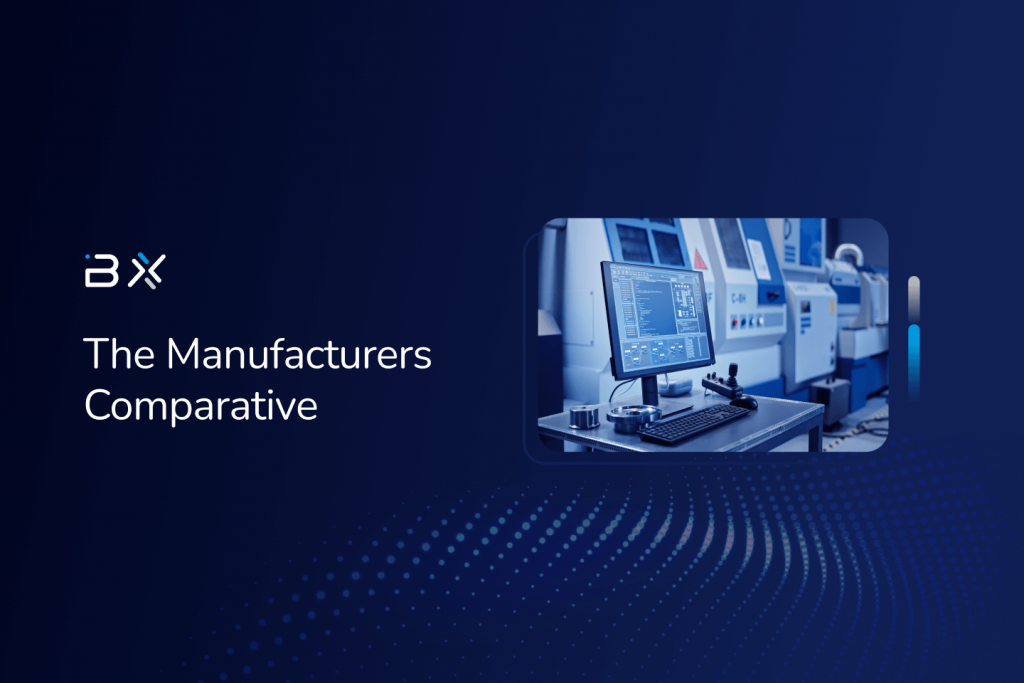
Staying nimble in today’s competitive and challenging industry If you are a manufacturer in today’s competitive market, simply knowing how your company compares to other manufacturers likely won’t take you to the next level. It tells you where you’re coming up strong, meeting industry standards, or experiencing a shortfall; but it doesn’t exemplify what to do with that information or how to change course. Essentially, it’s a show and tell, but with just the tell. You’re only getting half the story, and as a result you may be making decisions off of assumption or best practice that may otherwise not be fit for your business at the time, or have become outdated practices anyways. You need real, actionable insights that provide a holistic view of all current and historical standings for everyone operating in your industry. It’s about pushing your business forward by opening up new opportunities for a more profitable operational system, without completely reinventing the wheel. Realistically speaking, how can you make that happen? Over here at Bearex, we’re all about greater efficiency and complete business optimization. We’re not about reinventing the wheel either, but rather how can the driver stay in the fast lane without putting the wheels at risk. That’s where the Bearex Insights Hub & Manufacturers Comparative comes into play. Custom fit to your organization, the Insights Hub connects and inputs all your important data, creating a one stop shop for data entry, analysis, and actionable steps to improve day-to-day operations. Layer that with a user-friendly interface that tracks current and historical results from your peers in the industry, the manufacturers comparative provides real up-to-date insights on multiple segments, from operational to financial to HR data. Small Data Wins Add Up to Greater Success The Manufacturers Comparative was created to fill the missing link between mediocre surveys and peer-to-peer questions across those in the industry. As we said before, knowing how your company compares to other manufacturers likely won’t save it or take it to the next level since you have already hit the home runs for your company. What the insight will do, however, is provide you ideas on where to look based upon the most profitable manufacturers as well as how you compare to others in your industry, in general. Together, this works to help you pinpoint the singles and doubles that are still out there, ensuring you still remain a valuable player in the game. The Manufacturers Comparative tracks 4 main areas: operational, financial, HR, and another that includes changing questions (example re: COVID-impacted changes). Let’s break it down: The Manufacturers Comparative has something for everyone and is not limited to the standard metrics that define the industry. If you have what you consider to be a unique company compared to others, you can still weigh and differentiate key areas such as: vacation policies, health benefits, shift premium, headcount information and more. Consider it your virtual think tank that is continuously updating to keep not only keep your business agile, but the entire industry knowledgeable as a result. Be Part of the Evolving Manufacturing Industry As your company adapts, so will the Manufacturers Comparative. Annually, our team will take in feedback from our users as a way to analyze our solution and strategically modify to meet the needs of everyone and create room for the types of insights users want to see. Each sector and sub-industry in the ever-evolving manufacturing industry fits a different mold when it comes to the action steps and types of solutions that will fit their needs best. Due to the fact there are unique economic demands and organizational structure – or as McKinsey calls it, activity types – that define each one separately, the Manufacturers Comparative will also work to help you keep those differentiators in mind so as to not overwhelm you by extraneous comparisons. Our team at Bearex looks forward to what’s next – for your business and the manufacturing industry as a whole. We understand the challenges that are starkly impacting supply chain productivity, labor shortages, and altogether rising costs as we continue through 2022. There is not one simple solution, but a necessity to remain adaptive and stay ahead of the learning curve when it comes to automation and preparation for long-term business continuity. We encourage you to be part of the conversation with us. Stay tuned for more to come on the Bearex Manufacturers Comparative. Contact Us
Using Data to Improve Performance Reviews

Employee performance & engagement is crucial to every business, and data accessibility can help. Ask yourself: How do you evaluate progress and productivity? Assess skills? Overarching, how do you measure success? All of these are ambiguous terms but each of value when it comes to reviewing what we know as performance. Now throw in the fact the variable being measured is not the performance of something but rather the performance of someone. This makes things even more ambiguous and subject to challenges, right? That’s just it – performance reviews can often be seen as challenging to any kind of professional across any business. So what does it come down to? As business professionals, we are expected to measure qualitative information about those we work with when we ourselves, are qualitative beings. We run on intangible and other qualitative thoughts that drive the behaviors and skill-sets we are being measured on in our roles. While there are role-specific quantitative measures of performance, it is these ambiguous and inexact components that are still necessary and universal to performance reviews across the board. Getting from Point A to Point B Effectively evaluating someone in their performance across all these areas in a quantitative way is easier said than done. Without a standardized method or process, it can be difficult to know where to begin or have any rule of thumb as it pertains to a comparative scale for which to base your assessment off of. Even if it’s a qualitative portion of the annual review your entire team has consistently been doing, it becomes a bit more convoluted for one to accurately and surely denote a true change has occurred (whether progression or area for improvement) when there is no numerical evidence. While empirical evidence exists, this can be a cause for disorganization and inconsistencies, maybe not always at the year-over-year individual level, but at the cross-sectional level of how one manager evaluates their direct reports over another manager. So what does this mean? Where do you go from here? Our 3-part answer is simple, and the process to get there doesn’t have to be complicated either: In this blog, we want to provide additional insight for Human Resources departments on various ways to implement data into performance reviews, and how it can easily become a process deployed across the entire organization. Let’s break down those 3 ways you can get started today: 1. Extract & Intake Your Data For anyone conducting a performance review, it’s likely you are already taking a step back to gain a full understanding of all that you’re evaluating. Even if simply done via observations and quick notes, this intake is allowing you to gain a full picture into the behavior patterns and skill sets that your colleagues are displaying over the course of time, not just in the present moment. While more informal, there is something to take away from this process. It mirrors exactly what organizations can and should allow the data available to them to produce – a full intake and wide lens gauge of their information. Take a step further, and organizations can use that data and information to drive a more thorough performance review-business wide. The key to ensuring this succeeds? Access. You don’t know what you don’t know. And when it comes to data, you may think you have the full picture when in fact you really are just looking through a smaller lens; so it appears nothing is missing, but much more lies outside the existing boundaries that would help provide context. That’s where data extraction becomes pivotal. At Bearex, we refer to the start of this process as ‘taking inventory’ – looking at the expansive network that is your most utilized reports, tools, databases, and meetings – to better understand the workflows in place and where gaps may result. In doing so, every necessary piece of data can be pulled from its source and become an interconnected web with one another for automated entry, analysis, and further action. Here are elements to consider in your inventory as it relates to extracting data that will improve performance reviews: 2. Structure Means Standardization Which Leads to Success Not only is analyzing existing data a helpful way to get more out of your performance reviews, but so is the method in which you conduct the appraisal itself. It’s likely we have all heard of KPIs before – Key Performance Indicators. And that’s exactly what they are. Key. Indicators. Of Performance. They don’t just have to be utilized when measuring operational efficiency or YOY budget, they can also effectively be applied for those who make the business run smoothly – the employees. As Performance Measure Specialist, Stacey Barr states, “Qualitative variables aren’t performance measures. But they are used to help us analyze our measures.” Whether you have a more qualitative and standardized method for performance reviews in place (e.g. graphic rating scales, checklists, goal tracking, etc.), or instead a more fluid and conversational approach (e.g. self-evaluations, competency assessment, etc.) it is critical to assess how effective that method currently is, or could be, at achieving the end goal of a balanced review that promotes further development. What works at one business may not work at the next, so be wise when comparing across those in your segment or industry, and remember that consistency across others in the business and consistency across time remains necessary. This ensures objectivity and accountability for everyone involved. The best way to ensure your method is objective and becomes standard for all teams, whether more quantitative or qualitative, is to ensure all information is accessible. 3. Allow Everyone to Learn with Full Accessibility To evaluate two colleagues without the same information available is to compare apples to oranges. And to translate one review as a determining insight for the rest of the team is to say you’ve only ever tried Gala apples. No two people are alike, this will never change. That’s why accessibility, consistency, and integrity are so
We are Bearex

Business impact that goes beyond the data – from access to insight, measurable change starts here. Data Driven Business Management At Bearex, who we are explains what we do, and what we do defines who we are. No solution can be found and no problem can be uncovered unless we know your business on a personal level and what you use to define success. In order for our team to know yours, it’s important you also know what makes Bearex, Bearex. We strive to show businesses the potential they have to make great decisions and spot the exceptions when their data can be harnessed to become more accurate, accessible, and applicable. To break it down: Who we are: A team of data analysts, business management professionals, and technical solutions architects who work to develop a system-wide solution that harnesses data to drive your team’s actions. What we do: We empower business leaders to quickly discover insights hidden within your company’s data so every decision is a sound one. How we do it: With ongoing support and strategic recommendations, we handle everything from setup, to data connection, and full dashboard development. We deliver on the understanding that the process to finding a solution isn’t always linear, nor absolute. That’s where two important values remain the foundation of our services – organizational unity and business continuity. More simply put, operating on the now and focusing on the future. Every strategic business decision must be made with both in mind – ensuring there is cohesiveness across the status of current issues, top initiatives, and systems operating now; and supporting the goals in place for further growth, agility and mission-wide success. With this mindset we also offer professional EOS implementation, with a certified EOS Implementer, in order for you to take your business to the next level. The Bearex Difference All this considered, you may still be asking, what makes Bearex different? Why not look elsewhere or develop internally? When it comes to the way we work, our goal is to make a day-to-day impact on your business in a way that causes minimal to no interruption to your everyday processes, technology and people. We’re not here to implement a solution and change every aspect of how you operate only to leave you wondering how to sustain it with your existing resources. We will implement a solution that allows you to continue business as usual but makes more effective and efficient use out of those processes, technology, and people that run it; all while remaining conscious of your bottom line. Consider us your part-time data and business analyst, saving you from the budget risks and resource constraints that also come with implementing data analytics internally. Once you’re up and running, the Bearex team will continue to support you with these three priorities in mind. We want to be your guide in: Bearex operates as your complete data insights team, creating an Insights Hub for your organization’s reporting, analytics, and data entry. The Insights Hub will drive your team’s day to day activities providing one place all systems merge and highlight the most important outliers that are causing inefficiencies. Bearex replaces the hassle of excessive resource allocation and expense that would otherwise go towards purchasing a dashboarding tool and hiring both a business analyst and custom app developer. To learn more about our full process in detail, check out Our Process here. Where We Came From As Tom Jurasek, our CEO & Visionary, would say, “Bearex was born out of passion for the importance of connecting – connecting data, connecting employees and connecting great leaders to great results.” We take pride in our business passion, which is why we look forward to restoring the passion that lies in those who continuously work hard at yours. That’s why you’ll often hear us say it’s about making sure you can start working on your business, not just in it. Bearex got it’s pillars when a CPA (CEO Tom Jurasek), Dashboard Developer (CTO Stephen Shaffer), and EOS Implementer (COO Andrew Gissal) came together with this shared passion and a first-hand understanding on the importance of accessible information to make better business decisions and drive change forward. Thomas B Jurasek Tom – the CEO & Visionary at Bearex, empowering data insights. With a background in CPA and CFO for-hire, Tom strives to simplify and help organizations have the information needed to make an informed decision. Andrew J Gissal As COO & EOS Implementer at Bearex, Andrew aims to help entrepreneurial businesses use data to gain traction through his experience in organizational leadership and startup sales & marketing. Stephen E Shaffer Steve is the CTO & Head of Dev Ops at Bearex, empowering data insights. Everything from data manipulation, to dashboard design and development, Steve is the go to for helping businesses solve problems by representing data in a usable way. Tom met Andrew & Stephen when he began building a secondary solution for clients of his CPA firm. Dashboards that connected to their systems started giving leaders a look into the most important information, displayed on charts and graphs rather than spreadsheets. As the solution developed it was evident that there was a high demand, and Bearex was founded as its own entity. As clients utilized the Bearex Dashboards, a need grew: the ability to capture data that was locked in disparate spreadsheets, note pads, sticky notes, etc. The Bearex Insights Hub was born to incorporate every crucial data entry in order to combine with other systems to tell a complete story. With all the information, a framework to utilize the data to create a culture of accountability and gain traction became clear. Adding EOS (Entrepreneurial Operating System) to the solution would play a pivotal role in not only making the data now accessible, but showcase how to use it in day to day operations. It allows for a seamless cohesion between your systems and the Bearex solution that provides the innate shared knowledge that comes with an